
YANNICK LOWERY
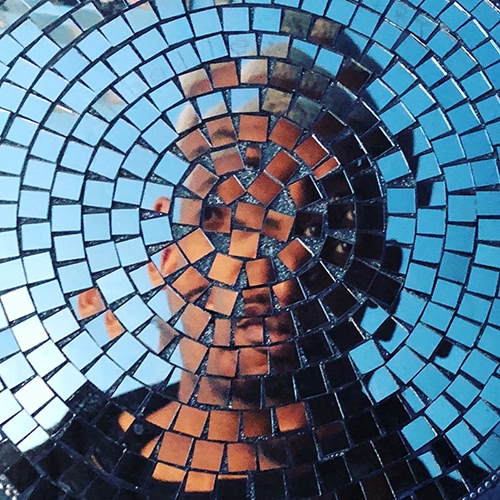
Proof of Life: In Conversation with Yannick Lowery
As part of the Proof of Life residency, Yannick reflects on memory, movement, and the role of documentation in his evolving practice.
Outside of your work, how do you personally demonstrate proof of life?
I think the work that I do is so closely linked to my life that it’s hard to separate the two. A lot of what I do involves going outside, being in the environment, moving through space.
I spend a lot of time walking, biking, just being present in the world. That’s where I feel most connected. That’s where I notice things.
I’m also someone who picks up hobbies pretty frequently. I like learning new things, trying things out, even if I don’t stick with them forever. It’s a way of staying engaged, staying curious.
How does that connect to your interest in memory and documentation?
Memory is fleeting. It deserves reflection, documentation, and care.
A lot of my work is about trying to hold onto something that might otherwise disappear. That could be a place, a moment, a feeling.
There are memories that only exist between the people who experienced them. Once those people are gone, those memories are gone too. That’s something I think about a lot.
So I’m interested in what it means to document, not just in a technical sense, but in a human sense. What are we choosing to remember? What are we letting go?
What are you exploring during this residency?
I’m working on a project that deals with matriarchal memory in West Philadelphia, specifically in Parkside.
It’s about lineage, about the women who have held families and communities together, often without recognition.
I’m trying to create something that honors that while also asking how those stories are passed down. What gets remembered? What gets lost?
Rapid Response
Favorite meal in Philadelphia:
Anything from a neighborhood spot in West Philly
What’s on repeat right now:
A mix of ambient music and whatever I find while digging
A performance that stayed with you:
Work that happens outside of traditional theater spaces
A place in Philadelphia that resets you:
Being outdoors, especially in quieter parts of the city
Yannick Lowery (He/Him) is an interdisciplinary artist based in Philadelphia, originally from New York City. Drawing from the cultural and visual histories of both cities, his work explores memory, identity, and narrative through a range of mediums including collage, photography, animation, and sculpture.
Using archival imagery alongside his own photographic work, Lowery constructs layered visual compositions that invite reflection and reinterpretation. His practice often incorporates illustrated proverbs, historical references, and speculative elements that guide viewers through spaces of cultural introspection and imaginative storytelling.
Through material exploration and world-building, his work creates entry points into conversations about history, place, and the ways personal and collective memory continue to shape contemporary experience.
Project Description
During his residency, Yannick Lowery will continue developing his ongoing project of “unmapping” The Black Bottom through interviews with community members who are willing to share personal histories of the neighborhood.
These conversations will focus on lived experience, including schools, churches, gathering spaces, and everyday life, building a collective archive of memory rooted in place.
These oral histories will serve as both documentation and creative source material. Lowery will translate these narratives into visual works using handmade paper, collage, and cyanotype processes, bringing memory into material form.
The residency will also include opportunities for public participation through storytelling workshops and one-on-one interviews, creating space for community members to contribute directly to the archive. Additional workshops will invite participants to imagine “The Black Bottom” through visual interpretation, connecting past, present, and future narratives.
At its core, the project centers memory as both inheritance and responsibility, offering counter-narratives of Black life while preserving stories that continue to shape the cultural identity of the neighborhood.