Proof of Life: A Conversation with our Artists in Residence (Part 2/3)
How the Work is Made
Painted Bride Project Space
Public Engagement Week: May 9 to 17, 2026
For over five decades, Painted Bride has been a space where artists and community meet in real time. Not just to present work, but to develop it, question it, and share it while it is still taking shape.
At Painted Bride Project Space, that legacy continues through Proof of Life. Proof of Life is an intentional practice, shaped by lived experience and real stories worth repeating. This is artist-driven, people-powered work, rooted in presence, exchange, and the belief that creativity belongs in community.
Artists bring the work. People bring the energy. Community makes it matter.
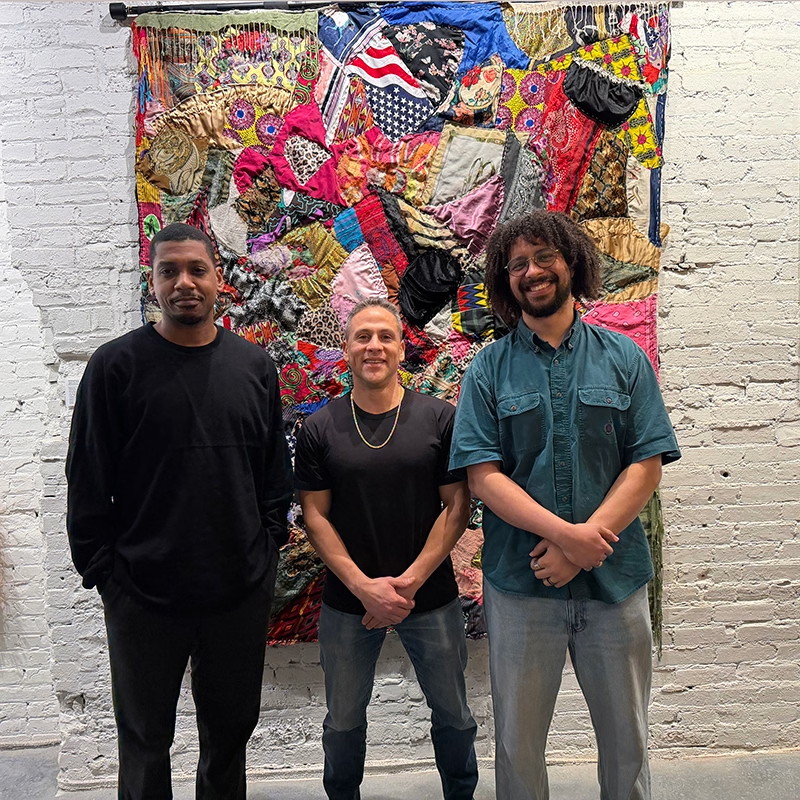
In April, Deputy Director Nina Ball and Communications Specialist Phil Sumpter sat down with YANNICK LOWERY, ANDRÉS CISNEROS, and TAJ RAUCH in conversation. Last week, we shared with you who they are when the work is not happening. This week, we go inside the work itself.
This is not finished work. It is the process, live and in motion. What does it mean to make something during a residency? What changes when you have time, space, and a community willing to be part of the process? And what is each artist actually trying to reveal, to audiences, to collaborators, to themselves?
The answers are distinct. They should be. These are three different artists making three very different things. What they share is a commitment to a process that is open, visible, and shaped by the people in the room.
The Process, Live and in Motion
Each artist came into this residency with work already underway. What the Painted Bride Project Space gave them was something harder to find: time, designated space, production-quality resources, and collaborators who could show up fully. Here is what shifted.
Yannick Lowery
Yannick’s practice has always moved between the personal and the communal, drawing from his own memories first, then widening outward into the places and people those memories belong to.
“My work has always been drawn from narratives and inspired by location. Stories and memories of my own personal experiences have led my practice of self-discovery. Similarly, I’ve been evolving my work to use this method in communities, to discover nuance and shift perceptions of areas seemingly consumed by tragedy.”
The current project, Between Matriarchs of Parkside, makes that shift explicit. It is not Yannick’s memory he is working with now. It is the neighborhood’s. Specifically, Parkside in West Philadelphia: the women who held it together, the stories that exist only between the people who were there.
“Philly is home and has shaped much of my practice. These neighborhoods have so many stories to tell and offer boundless legacies to unravel.”
What the residency has given him is the institutional frame to do that work with care, and with the community it belongs to.
“The location of The Bride is significant to my work because it bridges a gap to this community. Because art spaces can be so alienating, it’s important for me to bring them in and show reverence to their histories.”
Taj Rauch
Taj makes immersive, gamified work, participatory theater where the audience does not just watch but chooses, and where those choices shape what happens next. Every previous project, he said, was built under pressure.
“Every previous immersive project of mine has always felt the pressure of a lack of resources and an impending deadline.”
This residency changed that.
“Being given the opportunity to have a designated space with production quality resources is changing the game for not only how I get to see my own work develop, but for how my team is beginning to see themselves and their own value.”
That last part matters. It is not just about what the work can become. It is about what the people making it can become. Time and support have shifted something in the room.
“To instead be able to have ample time to rehearse with my actors, all in the effort of culminating towards a public-facing playtest, makes my team and I feel more invested in the future of this piece. That’s all because Painted Bride took an interest in offering us a platform to develop our very best work yet.”
The residency also changed how he thinks about his own role.
“It has taught me the value of not trying to do everything myself. I usually take it upon myself to write, direct, design, and produce all of my work. However, being in space with my actors and pursuing a more devised approach, all under the Painted Bride umbrella offering us the time and support to be present with each other, has taught me how much further we can develop work together when everyone has the chance to provide input.”
Andres Cisneros
For Andres, the residency is the crucible for something he has been building across decades of musical experience, a live experiment in how songs actually come to exist.
The project, Philly Cancionero, draws on Afro-Caribbean traditions, specifically salsa, and asks a question that takes a whole culture to answer: where does a song come from?
“The purpose is to recreate how songs are constructed over the years, over time, something that somebody said in the neighborhood, and it carried word of mouth, and then somebody decided to compose it. That could take a year, three years, four years. That could take a long time and go through many iterations.”
Andres is going to compress that process into a single evening, three times. Audience members will write responses to a prompt as they arrive. He will read one, and from it, improvise a song on the spot.
“The experiment is to make the audience understand that this is how, in Latin American music and our folklore, songs are created. So I’m speed-processing that in three different opportunities on that evening.”
The band he has assembled reflects the same logic. A Cuban collaborator. A mixed Puerto Rican and Venezuelan piano player. A Jewish bassist.
“I am attempting to recreate how salsa came to be in the first place.”
What Are You Most Interested in Revealing?
Beyond the residency itself, each artist carries a specific question into the room. A landscape they are trying to make visible. What follows are those questions, in their own words.
Yannick on memory
“Memory is very fleeting. And I think it’s kind of effervescent in the way that it can look different for different people. And I think it’s in a space where it deserves real reflection and documentation, and archiving in a way that is not just for the sake of record keeping, but thinking about how the future is shaped.”
He referenced a quote he heard from Robin D.G. Kelley at a recent show at the Barnes: how we proceed with repair depends on how we remember.
“When you talk about the condition of memory right now, I think it’s in a state of flux where we’re hyper-consuming information, and we’re not doing a lot of review.”
For Yannick, the work with the Parkside community is an answer to that. From the outside, it reads as a deliberate slowing down, a looking backwards that is less about nostalgia than about structure, about understanding what has to be remembered before anything can move forward.
“A lot of my work has been with that purpose of looking backwards, specifically within Black communities, in the ways that we can reshape the trajectory of what has happened in some cases into something that is a lot more, not just ideologically optimistic, but just realistically beautiful and better and brighter.”
He named himself, carefully, as one keeper among many.
“I like to think that I’m playing my role in that.”
Taj on human behavior
“The short answer for my entire artistic practice: I’m interested in creating experimental, gamified works that position the audience as a protagonist. And what that does is put a mirror to them.”
In All Heathens Go to Heaven, that mirror is trained on a specific and urgent subject: toxic masculinity, and specifically what young men in Philadelphia are absorbing from the figures they are told to look up to.
“I work as a teacher in Philadelphia for college and high school students, and I’ve noticed the lack of male role models in this city. It’s harder for young men to seek out role models in their city when they have a phone in their pocket that instantly connects them to a social media feed filled with toxic male icons parading as morally righteous.”
He named Andrew Tate. He named Elon Musk. Not to relitigate them, but to mark the distance between what those figures represent and the actual landscape of young men growing up in Philadelphia.
“This piece hopes to instill a sense of doubt in these icons, as well as a sense of self-worth in young men, so that they might seek out better role models in our city instead of trusting those who speak loudest on a virtual platform.”
And the formal structure of the work, the gamified, choice-driven, participatory design, is the delivery mechanism for that.
“Games are so interesting because we never play as ourselves. We use experiments and games as an opportunity to explore who we could be in a given situation. And I love that.”
Andres on sound and cultural landscape
Andres has been deliberately steering away from the first person in his songwriting, a choice that is both artistic and strategic.
“Dance music is music to get loose on. And I’m designing this for the dancers. I’m steering away from the ‘I,’ from the first-person perspective, trying to be as objective as possible.”
The goal is specificity that becomes universal. He writes from his own experience, Venezuelan, Latino, immigrant, Philadelphian, but shapes the language so it can land somewhere else.
“It’s for me to know what I wrote the songs about. But if I generalize them and I’m able to have the listener being in their moment, in a spin, and they hear something that clicks, and they can identify with that, great. If not, at least they’re dancing to the beat.”
He described a recent performance where a young, largely non-Latino crowd danced to his covers. That moment confirmed something.
“I don’t have to write necessarily for the Latino crowd. I am writing for everybody, coming from, obviously, my experience as a Latino.”
What he is building draws from a wide source pool: Venezuelan folk music, Cuban rhythms, hip-hop production, and the neo-soul era he fell in love with when he arrived in Philadelphia. Cachaito. Anga Diaz. Eddie Palmieri. The Roots.
“I am attempting to recreate how salsa came to be in the first place.”
Public Engagement Week | May 9 to 17
What to Expect
The work is in progress. Each of these artists is still building, still testing, still in the room with their collaborators, figuring out what the piece needs to become.
That is not a caveat. It is the point. Public Engagement Week is not a premiere. It is an opening. A chance to step into the process while it is still alive, still shifting, still shaped by who shows up.
The question is not whether the work is ready. The question is whether you are.
Check out the full schedule and reserve your FREE spot today!
Next week, read Part 3: Why to Show Up
Read Part One